
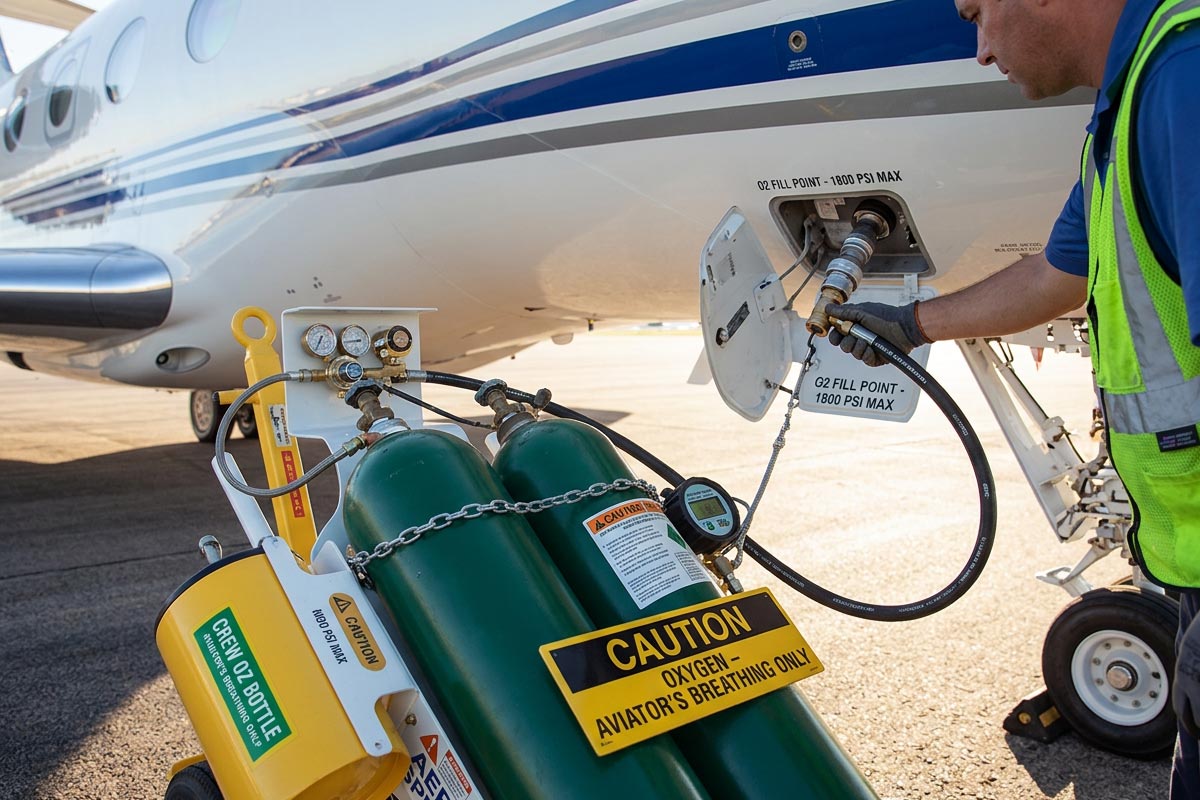
Aircraft oxygen servicing requires oxygen-clean equipment, correct pressure control, approved maintenance procedures and suitable service carts, regulators or boosters for the aircraft system being replenished. The right setup depends on the aircraft oxygen system, required fill pressure, donor bottle pressure, desired fill time and whether a booster is needed to complete the fill safely and efficiently.
AviationSpares’ oxygen and nitrogen service carts provide a natural starting point for operators comparing bottle capacity, regulator configuration and booster requirements. For higher-pressure work, the boosters and regulators range is directly relevant because oxygen servicing is not simply a case of moving gas from one bottle to another. The servicing equipment must suit the aircraft, the pressure requirement and the safety procedure.
Aircraft oxygen servicing explained: why pressure control matters
Pressure control matters because aircraft oxygen systems are high-pressure systems where incorrect equipment, contamination or poor procedure can create serious fire and safety risks. The fill pressure should be confirmed from approved maintenance data, then delivered through oxygen-compatible equipment that is clean, controlled and suitable for aircraft servicing.
- Oxygen supports combustion, so the work area, tools and equipment must be kept clean.
- Servicing must follow the aircraft maintenance manual or other approved maintenance data.
- Fill pressure should not be guessed from the service cart or donor bottle pressure.
- Regulators, gauges, hoses and adapters must be suitable for oxygen service.
- Booster use affects achievable fill pressure, gas recovery and servicing efficiency.
CAA maintenance guidance defines service or lubrication as replenishing a component or system, including oxygen, to the condition specified in the appropriate maintenance manual. That supports the central buyer point: aircraft data comes first, then the servicing cart, regulator or booster is chosen to match it. The CAA regulatory library also includes oxygen-system inspection items such as checking oxygen bottle hydrostatic-test date expiry and observing all safety precautions.
What pressure is needed for aircraft oxygen servicing?
The required pressure depends on the aircraft oxygen system and must be taken from approved maintenance data, not from the service cart alone. The servicing equipment must then be able to deliver that pressure safely, accurately and without contamination.
| Servicing requirement | What it means in practice |
| Low-pressure transfer | A regulator may be enough if donor pressure remains higher than receiving system pressure. |
| Higher-pressure charging | A booster may be needed when donor and receiving pressures begin to equalise. |
| Repeated fleet servicing | Multi-bottle carts reduce cylinder changeovers and make repeated replenishment more practical. |
| Ramp or hangar movement | Bottle cart design, steering, towing and manoeuvrability affect day-to-day usability. |
| Oxygen cleanliness | Equipment must be oxygen-compatible and free from oil, grease and contamination. |
What does an oxygen booster do?
An oxygen booster increases outlet pressure so the aircraft system can continue to be filled when donor bottle pressure has fallen too low for direct transfer. Without a booster, gas transfer slows or stops when the donor bottle and aircraft system pressures equalise.
Without a booster, oxygen transfer can slow or stop once the donor cylinder and aircraft system begin to equalise, which may leave usable oxygen in the cylinder. A booster helps recover more of that gas by increasing outlet pressure, allowing oxygen bottles to be drawn down further before replacement. For example, the OB-30 Oxygen Booster Pump can pump oxygen bottles down to 250 psig, rather than leaving higher residual pressure unused.
OB-30 vs HIHP-20648: which oxygen booster is suitable?
The right booster depends on the aircraft’s required fill pressure, the donor bottle pressure available and whether the operator needs a cart-mounted or cylinder-mounted solution. The booster should never be selected by output pressure alone; oxygen compatibility, procedure, gauge accuracy and connection requirements also matter.
| Oxygen booster | Published figures | Best suited to |
| OB-30 Oxygen Booster Pump | Uses 80 psi (5.5 bar) drive pressure, produces 2,200 psi (151.7 bar) oxygen pressure and can pump bottles down to 250 psig (17.2 bar). | General oxygen servicing where 2,200 psi (151.7 bar) output is suitable and gas recovery is important. |
| HIHP-20648 Cylinder-Mounted Oxygen Booster | Delivers roughly 3,450 psi (237.9 bar), works with inlet pressure down to about 300 psi (20.7 bar), and has a typical compression ratio of about 11:1. | Higher-pressure aircraft oxygen servicing where compact cylinder-mounted boosting is useful. |
For higher-pressure servicing, the HIHP-20648 cylinder-mounted oxygen booster gives a useful comparison point because it is listed as delivering roughly 3,450 psi (237.9 bar) for aircraft servicing, with inlet pressure down to about 300 psi (20.7 bar) and a typical 11:1 compression ratio.
How do oxygen service carts affect fill time?
Fill time depends on the pressure difference between the donor cylinder and aircraft system, the number of bottles available, regulator or booster capability, hose and fitting restrictions, and the aircraft’s approved servicing procedure. A larger cart does not automatically mean a faster safe fill, but it can reduce cylinder changes and make repeated servicing more efficient.
| Cart setup | Practical advantage | Best fit |
| 2-bottle oxygen service cart | Compact, hand-movable and supplied with a high-pressure regulator system. | Smaller operators, hangar servicing and lower-volume oxygen replenishment. |
| 3-bottle oxygen service cart | Can include an OB-30 booster, 3-bottle oxygen regulator, 15 ft (4.57 m) delivery hose and combination charge adapter. | FBOs and MROs needing ramp or hangar servicing with better bottle capacity. |
| 4-bottle oxygen or nitrogen service cart | Accepts four standard K-size 9 in x 56 in (229 mm x 1,422 mm) oxygen or nitrogen bottles. | Higher-volume fleet support or operators wanting a configurable oxygen/nitrogen cart platform. |
| Complete oxygen/nitrogen platform | Can combine cart, regulators, booster systems, hose kits and adapters. | Operators wanting a more complete servicing setup rather than a cart-only configuration. |
For low-volume work, a 2-bottle oxygen service cart is a practical example because it is hand-movable and includes a high-pressure regulator system. For more demanding ramp or hangar servicing, a 3-bottle aircraft oxygen system service cart is listed with a booster and regulator system and can be used remotely on the ramp or in the hangar. For operators building a configurable platform, the 4-bottle oxygen or nitrogen service cart accepts standard K-size 9 in x 56 in (229 mm x 1,422 mm) bottles and can mount oxygen or nitrogen booster systems.
What safety requirements matter during aircraft oxygen servicing?
The main safety requirements are oxygen cleanliness, approved procedures, pressure control, contamination prevention and trained personnel. Oxygen equipment must be kept away from oil, grease and other flammable contaminants, and the aircraft maintenance data should define the correct servicing condition.
CAA CAP 411 describes servicing as replenishing systems such as oxygen to the condition specified in the appropriate maintenance manual, which is a useful authority-backed reminder that the cart or booster should never override the aircraft procedure. In practical terms, oxygen servicing equipment should be stored, handled and connected as a clean system, with no improvised fittings or unverified components.
EASA CS-25 also provides useful context for why oxygen system performance is safety-critical. For protective breathing equipment, it specifies a 15-minute oxygen supply at 8,000 ft (2,438 m) with a respiratory minute volume of 30 litres per minute. It also states that 300 litres of free oxygen can be considered a 15-minute supply for a demand system at the prescribed altitude and minute volume. These figures are certification requirements rather than service-cart sizing rules, but they help show why oxygen supply, leak prevention and correct maintenance matter.
Which oxygen servicing figures are most useful for buyers?
The most useful figures are booster output pressure, drive pressure, minimum donor bottle pressure, bottle size, regulator delivery range and any published oxygen-cleanliness requirements. These figures help operators compare real servicing capability without pretending that one setup is right for every aircraft.
| Figure | Why it matters |
| 2,200 psi (151.7 bar) | Useful benchmark for the OB-30 oxygen booster output pressure. |
| 80 psi (5.5 bar) | OB-30 drive pressure, relevant where shop air or drive supply has to be planned. |
| 250 psig (17.2 bar) | OB-30 bottle recovery figure, showing how low donor bottles can be pumped down. |
| 900-1,000 psi (62.1-68.9 bar) | Potential unused bottle pressure without a booster after system equalisation. |
| 3,450 psi (237.9 bar) | HIHP-20648 output benchmark for higher-pressure oxygen servicing. |
| 300 psi (20.7 bar) | HIHP-20648 inlet pressure benchmark when the supply cylinder is nearly depleted. |
| 11:1 | Typical HIHP-20648 compression ratio, useful for understanding pressure boosting capability. |
| 9 in x 56 in (229 mm x 1,422 mm) | Standard K-size bottle dimensions used by AviationSpares’ 4-bottle cart. |
| 15 minutes at 8,000 ft (2,438 m) | EASA protective breathing equipment context for oxygen supply requirements. |
What equipment should operators check before buying?
Operators should check whether they need a basic oxygen regulator setup, a multi-bottle service cart, an oxygen booster or a complete oxygen/nitrogen servicing platform. The answer depends on the aircraft systems being serviced, how often oxygen replenishment is carried out and whether pressure equalisation is leaving useful oxygen behind in donor bottles.
- Aircraft oxygen system fill pressure and servicing procedure
- Regulator delivery range and gauge accuracy
- Booster output pressure and minimum inlet pressure
- Bottle capacity and cart configuration
- Hose length, fittings, charge adapters and bleed arrangements
- Oxygen-clean materials and maintenance requirements
- Whether the equipment is mainly for hangar use, ramp use or both
- Whether staff can service the system without unnecessary cylinder changes or manual handling issues
For fine control during connection, flow adjustment and disconnect, an O2 and N2 bleed and flow valve is a useful supporting product to mention because it is listed as allowing oxygen or nitrogen service cart flow adjustment and high-pressure purge before disconnect from the aircraft service port.
Final answer: what oxygen servicing equipment do you need?
Aircraft oxygen servicing equipment should be chosen around the aircraft’s required fill pressure, oxygen-cleanliness requirements, servicing volume and whether a booster is needed to overcome pressure equalisation. For low-volume servicing, a regulated two-bottle oxygen cart may be enough. For repeated fleet servicing, a three- or four-bottle cart may be more practical. Where donor bottle pressure limits the fill, an oxygen booster such as the OB-30 or HIHP-20648 can help recover gas and achieve the required outlet pressure, provided the equipment matches the aircraft maintenance data.
- Start with the aircraft maintenance manual or approved maintenance data.
- Confirm the required oxygen fill pressure and system limits.
- Choose a regulator when controlled pressure reduction is enough.
- Choose a booster when donor pressure is too low to complete the fill efficiently.
- Choose a larger service cart when bottle capacity and repeated servicing matter.
- Prioritise oxygen cleanliness, safe handling and trained procedures over filling speed.
FAQ
What pressure is used for aircraft oxygen servicing?
The required pressure depends on the aircraft oxygen system and must be taken from the aircraft maintenance manual. The service equipment must be able to deliver that pressure safely and accurately.
What does an aircraft oxygen booster do?
An oxygen booster increases outlet pressure so the aircraft system can continue to be filled when donor bottle pressure begins to equalise. This can reduce wasted oxygen and improve servicing efficiency.
Does an oxygen booster make filling faster?
It can help maintain filling capability, but safe fill time also depends on the aircraft procedure, pressure differential, regulator flow, hose setup and temperature considerations. Faster is not always better with high-pressure oxygen servicing.
What is the difference between an oxygen regulator and an oxygen booster?
A regulator controls pressure from a higher-pressure source, while a booster actively increases outlet pressure when the supply pressure is too low for the required fill.
What is the biggest safety risk during oxygen servicing?
Contamination is one of the biggest risks. Oxygen-compatible equipment must be kept clean and free from oil, grease and flammable material.