
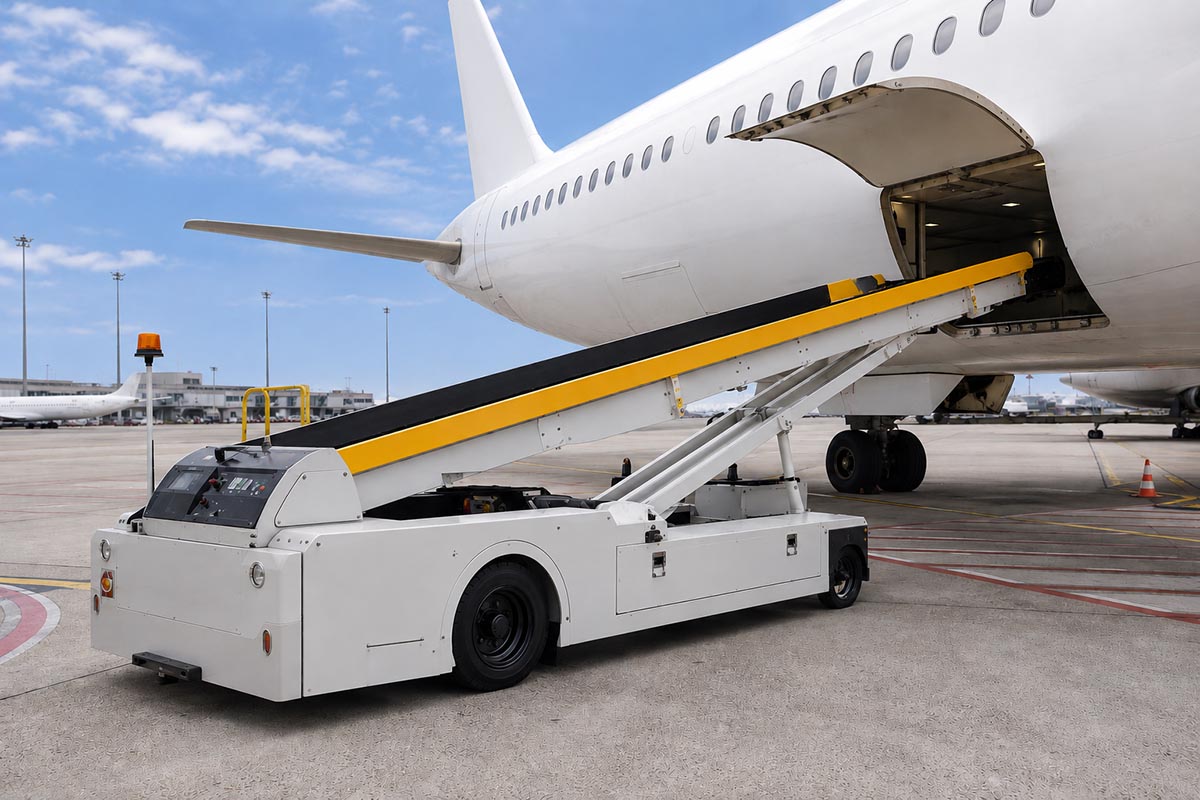
Modern belt loaders are helping airports reduce delays and improve efficiency
Airports are under constant pressure to turn aircraft around quicker than ever, with 2025 breaking all existing records on passengers, with the Civil Aviation Authority reporting 302 million passengers passing through the UK’s airports.
Meeting this increase in demand while also maintaining safety, reliability, and passenger satisfaction is no easy feat. Modern belt loaders are playing a major role in helping ground handling teams improve turnaround times by increasing baggage handling efficiency and reducing downtime while still supporting safe ramp operations.
With airlines aiming to minimise aircraft time on the ground, even small improvements in loading and unloading procedures and equipment can have a significant operational impact incrementally.
What Is a Belt Loader?
A belt loader is a type of airport Ground Support Equipment (GSE) that utilises an adjustable, moving conveyor belt which is used by ground crew to load and unload baggage and other cargo from aircraft holds.
They are commonly used with:
- Narrow-body passenger aircraft
- Regional jets
- Smaller cargo aircraft
- Aircraft with lower cargo hold access points
Belt loaders are designed with improved ergonomics, greater reliability, and lower-emission power systems over their older equivalents, with many being entirely battery powered thus eliminating emissions completely.
How Modern Belt Loaders Improve Airport Turnaround Times Faster Baggage Loading and Unloading
Newer belt loaders help baggage teams work more efficiently by:
- Reducing manual lifting distances
- Improving baggage flow consistency
- Allowing quicker loading and unloading
- Supporting faster aircraft servicing during busy periods
- Improved drive motor technology, improving the speed of the conveyor
This helps reduce overall aircraft ground time and improve gate availability.
Improved Reliability Reduces Delays
Older equipment can contribute to operational delays through breakdowns or maintenance issues. Modern belt loaders increasingly feature:
- Improved hydraulic systems
- More reliable drivetrains
- Better weather resistance
- Easier preventative maintenance access
- Built-in diagnostics and fault monitoring
Reducing equipment downtime helps ground crews maintain tighter schedules.
Electric Belt Loaders Are Becoming More Common
Many airports are investing in electric ground support equipment as part of wider sustainability initiatives. Electric belt loaders offer several operational advantages, including:
- Lower emissions
- Reduced noise levels on the apron
- In places like Europe, where electricity is cheaper than fuel, cheaper running costs
- Lower maintenance requirements
- Smoother operation – a battery change is quicker than refuelling diesel
- Improved compatibility with airport sustainability targets
The Airport Operators Association has highlighted sustainability and operational efficiency as major priorities for UK airports and the government, with this as an ongoing push to reduce carbon emissions across the aviation industry wherever possible.
Enhanced Safety Features Support Efficient Ramp Operations
Every year brings new innovations across the board and safety is no exception. Modern belt loaders increasingly include safety-focused features designed to reduce accidents and operational disruption. Common features now include:
- Sensors to greatly mitigate the risk of aircraft incursions – the biggest improvement by far
- Automatic braking systems
- Improved lighting and visibility
- Safer operator platforms
- Anti-roll and anti-collision systems
Many modern belt loaders, such as the PULLEY69Ce come with what are known as Aircraft Damage Prevention Systems (often called ADPS), these are innovative systems that functions by:
- Having an onboard system that combines sensors and actuators
- Coordinating GSE approach to aircraft.
- Controls approach speed and stopping.
- (With certain belt loaders and stairs) automatically lowering.
These systems are proving revolutionary in mitigating damage to aircraft and other GSE, reducing maintenance and repair costs, staff injuries and airport downtime.
Better Ergonomics Improve Ground Crew Productivity
Ground handling work can be physically demanding, particularly during peak travel periods. Modern belt loaders often include:
- Adjustable conveyor heights
- Improved operator controls
- Better visibility from driving positions
- Smoother conveyor operation
- Reduced vibration and noise levels
Smart Technology Is Improving Equipment Management
Many airports and ground handling companies are introducing connected fleet technology to improve operational performance, with interconnected digital systems utilising 5G and in some cases, AI, as this report by Ericsson explains. Modern systems allow operators to:
- Monitor equipment usage
- Schedule maintenance more effectively
- Reduce idle time
- Track operational performance
- Improve equipment availability
FAQs
How do belt loaders improve airport turnaround times?
Belt loaders speed up baggage loading and unloading, helping aircraft spend less time on the ground between flights.
Are electric belt loaders becoming more common?
Yes. Many airports are investing in electric ground support equipment to reduce emissions, lower noise levels, and improve operational efficiency.