
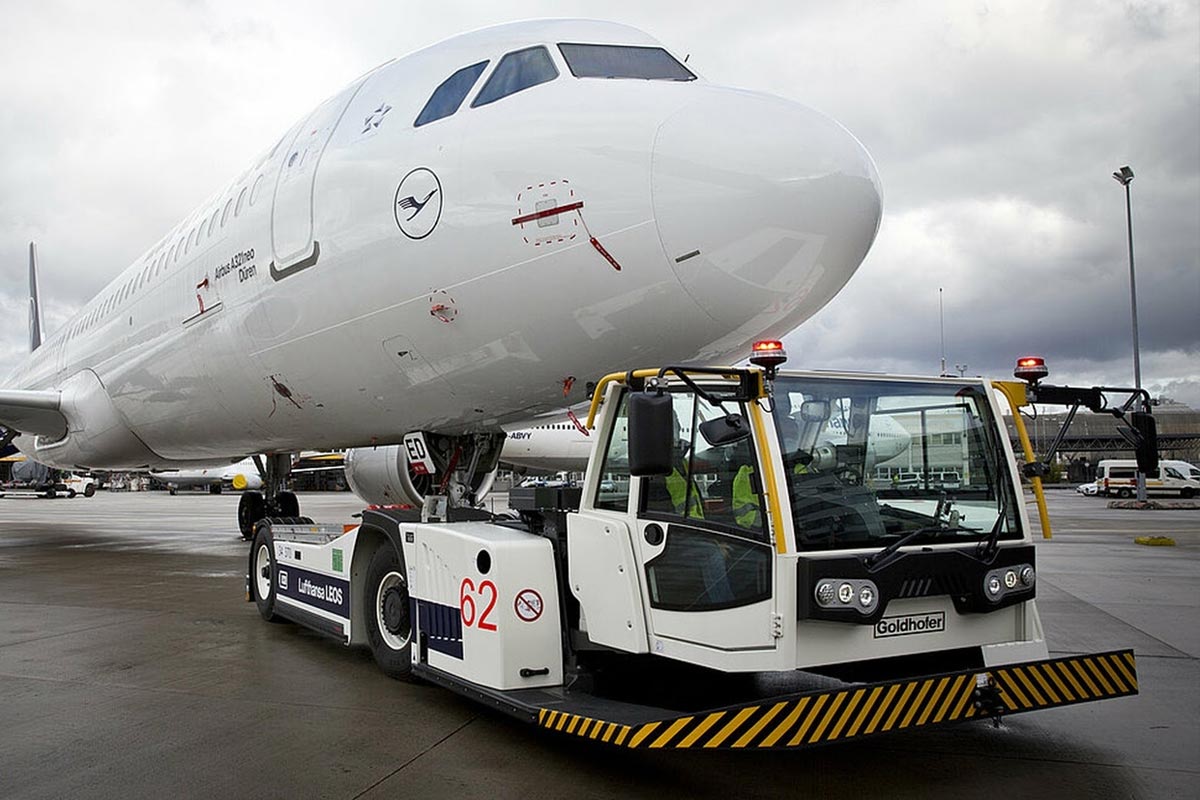
An FBO or ground handler should size an aircraft tow tractor by matching the tractor to the heaviest aircraft it regularly needs to move, then checking drawbar pull, towbar or towbarless compatibility, surface condition, gradient, towing distance and duty cycle. Aircraft weight is the starting point, but it is not the whole decision. A tug that looks suitable in a capacity table may still be the wrong choice if it cannot deliver safe traction, braking and visibility in the real operating environment.
Aircraft tow tractor sizing explained: what does capacity actually mean?
Tow tractor capacity usually refers to the maximum aircraft weight the tug is designed to move, but real-world towing performance also depends on drawbar pull, traction, braking, slope, surface condition and operator procedure. This is why a simple “aircraft weight equals tug size” approach can be too blunt for FBOs and ground handlers.
For example, the Eagle TT-8D diesel tow tractor provides a useful way to understand how tow tractor specifications translate into real-world suitability. Its 38,555 kg (85,000 lb) towing capacity indicates the maximum aircraft weight range it is designed to move, while its 35.6 kN (8,000 lbf) drawbar pull shows the pulling force available at the hitch to start and control movement. Its 4,173 kg (9,200 lb) service weight also matters, because the tractor’s own weight helps provide traction and stability on the ramp.
Engine output is another practical factor. The TT-8D’s 68 HP (51 kW) diesel engine supports repeated towing duties where operators need dependable outdoor performance, rather than occasional light hangar movements. Taken together, these figures show why tow tractor selection should not be based on aircraft weight alone. A suitable tug needs enough towing capacity for the aircraft, enough drawbar pull to move it safely, enough service weight for traction, and the right powertrain for the duty cycle and operating environment.
What figures should FBOs compare before buying a tow tractor?
The most useful figures are aircraft towing capacity, drawbar pull, service weight, loaded speed, turning behaviour, battery or fuel duty cycle, and any manufacturer caveats for wet, snowy or sloped surfaces. These figures are more useful than a generic “small, medium or large tug” label because they let operators compare equipment against the real fleet and ramp environment.
| Figure to compare | Why it matters | What to check |
| Towing capacity | Shows the maximum aircraft weight the tug is designed to move. | Compare against the heaviest aircraft regularly handled, with a sensible operational margin. |
| Drawbar pull | Shows the pulling force available to start and control movement. | Check where towing involves slopes, wet surfaces, snow risk or longer routes. |
| Service weight | Affects traction and braking, especially on contaminated surfaces. | A heavier unit may grip better, but may be less convenient in tight hangars. |
| Loaded speed | Shows how quickly the tug can move an aircraft under load. | Avoid oversizing purely for speed; control matters more than pace. |
| Turning radius | Matters in hangars and congested aprons. | Towbarless or contra-rotating wheel designs can help reduce wingtip movement. |
| Battery or fuel duty cycle | Determines how reliably the tug can complete repeated movements. | Check charge time, runtime, fuel capacity and maintenance access. |
Aircraft tow tractor comparison: which capacity range fits your operation?
| Fleet / operation type | Example product | Published towing capacity | Best fit |
| Piston aircraft and light corporate jets | eJP-3 & eJP-3L towbarless tug | 30,000 lb (13,608 kg) | Compact electric/towbarless movements for smaller FBO fleets. |
| Mid-size business jets and some regional aircraft | Eagle TT-8D diesel tow tractor | 85,000 lb (38,555 kg) | Mixed business aviation and regional support where AWD traction is useful. |
| Large business aircraft | eJP-10 towbarless tractor | 100,000 lb (45,359 kg) | Towbarless handling for larger corporate aircraft where manoeuvrability matters. |
| Regional and large-cabin business jets | JP125S towbarless tractor | 125,000 lb (56,699 kg) | Regional aircraft and larger business jet fleets. |
| Business, regional and lighter narrow-body movements | Eagle eTT-16 electric AWD tow tractor | 171,000 lb (77,564 kg) | Lower-emission electric towing where duty cycle and charging can be managed. |
| Narrow-body aircraft | Eagle XM-20/30 AWD tow tractor | 215,000 lb (97,500 kg) | Higher-duty narrow-body ramp and hangar operations. |
| High-capacity narrow-body and regional operations | Eagle XL-40 aircraft pushback tractor | 360,000 lb (163,293 kg) | Larger airports, handlers and heavier fleet coverage. |
For light corporate aircraft, the eJP-3 & eJP-3L towbarless tug provides a clear 30,000 lb (13,608 kg) benchmark. For larger regional and business aircraft, the JP125S is listed at 125,000 lb (56,699 kg), while the Eagle XM-20/30 reaches 215,000 lb (97,500 kg) for narrow-body-class operations. These figures are useful for shortlisting, but they do not replace aircraft-specific towing data or site-specific risk assessment. The final choice should still be checked against the aircraft manufacturer’s towing limits, the tug manufacturer’s operating instructions, towbar or adapter compatibility, local procedures and the actual ramp surface.
How do FBOs and ground handlers choose the right tow tractor?
FBOs and ground handlers should build a simple fleet matrix, then size the tug around the heaviest and most demanding aircraft movement they regularly perform. The aim is to choose a aircraft tow tractor that is safe for the biggest aircraft, practical for the smallest aircraft, and manageable for the team using it every day.
- List every aircraft type handled regularly.
- Record the maximum aircraft weight used for ground movement planning.
- Check aircraft towing limits, nose gear limits and approved towing procedures.
- Identify whether each aircraft uses a conventional towbar or can use a towbarless system.
- Record required towbar heads, adapters and nose gear interfaces.
- Separate hangar towing, pushback, repositioning and longer-distance towing tasks.
- Assess the ramp: dry concrete, wet apron, painted surfaces, gradient, snow or ice exposure.
- Choose a tractor with suitable capacity, drawbar pull, traction, braking and operator visibility.
For mixed business and regional operations, AviationSpares’ regional aircraft tugs category is a sensible place to compare diesel, AWD and electric options across a wider capacity range.
What aircraft weight rating should a tow tractor have?
The tow tractor should be rated above the heaviest aircraft it is expected to move, with extra allowance for wet surfaces, gradients, towing distance and how often the movement is repeated. A tractor that can move an aircraft in ideal dry conditions may not be a good operational match for exposed ramps, winter conditions or high-frequency handling.
- For light corporate aircraft, a 30,000 lb (13,608 kg) towbarless benchmark may be enough if the fleet mix is genuinely light.
- For mid-size business jets and some regional aircraft, an 85,000 lb (38,555 kg) class tug gives a stronger operational margin.
- For large business jets and regional aircraft, 100,000-125,000 lb (45,359-56,699 kg) towbarless options may be more appropriate.
- For narrow-body aircraft, published capacity figures of 215,000 lb (97,500 kg) or more move the selection into higher-duty pushback tractor territory.
For larger towbarless requirements, the JP125S towbarless tractor gives a useful regional and large-cabin business jet benchmark, with a published towing capacity of 125,000 lb (56,699 kg), cradle capacity of 12,500 lb (5,669 kg), full-load speed of 3 mph (4.8 kph) and an average full-discharge charge time of 8 hours.
What is the difference between towing capacity and drawbar pull?
Towing capacity is the maximum aircraft weight the tractor is designed to move, while drawbar pull is the pulling force available at the hitch. Both matter because starting an aircraft moving, controlling it on a slope and stopping safely are not the same as simply being rated for a particular aircraft weight.
| Term | Plain-English meaning | Why it matters |
| Towing capacity | The aircraft weight range the tractor is designed to move. | Useful for shortlisting against fleet weight. |
| Drawbar pull | The force the tractor can apply through the hitch or tow connection. | Important for starting movement and working on slopes or low-grip surfaces. |
| Traction | How effectively the tractor’s tyres transfer force to the ground. | Affected by service weight, drive type, tyre condition, ramp surface and weather. |
| Braking control | How well the tractor can slow and stop the aircraft movement. | Critical for close-quarters towing, hangars and busy aprons. |
The practical takeaway is simple: do not compare tugs by aircraft weight rating alone. If two tractors have similar published towing capacities, compare their drawbar pull, drive configuration, braking design, operator visibility and site-specific caveats before deciding.
Do you need a towbar or towbarless aircraft tug?
A conventional tow tractor uses a towbar matched to the aircraft, while a towbarless tug lifts or supports the nose gear directly and can improve manoeuvrability in tight spaces. The right choice depends on aircraft mix, adapter availability, hangar layout, towing frequency and how much time teams spend connecting and changing towbars.
AviationSpares’ towbarless tractors range is especially relevant for FBOs that need precise aircraft movement in hangars or congested apron areas, where reducing towbar handling and improving close-quarters control can save time.
| Option | Main advantage | Main limitation | Best suited to |
| Conventional tow tractor | Familiar, versatile and suitable for mixed operations with the correct towbars. | Requires towbar compatibility, towbar storage and correct head/adapters. | Larger ground handling teams and varied aircraft movements. |
| Towbarless tug | Strong manoeuvrability and no separate towbar for operation. | Aircraft nose gear compatibility and adapters must be checked. | FBOs, hangars and operators with tight movement areas. |
| Electric tow tractor | Quieter operation and lower local emissions. | Battery runtime, charging and duty cycle need planning. | Indoor, hangar and repeated short movements. |
| Diesel tow tractor | Strong outdoor performance and long-duty ramp use. | Fuel, emissions, servicing and indoor-use considerations. | Heavier-duty ramp and all-weather operations. |
What ramp conditions affect tow tractor sizing?
Wet surfaces, snow, ice, slope, painted concrete, turning space and towing distance can all increase the demand on an aircraft tug. This is why product capacity should always be read alongside surface-condition notes and local operating procedures.
The Eagle XM-20/30 AWD tow tractor is listed for aircraft up to 215,000 lb (97,500 kg) in dry conditions, with the product guidance noting that towing capacity can vary depending on wet or snowy surface conditions. That kind of caveat is exactly why ground handlers should avoid treating published capacity as a universal figure.
| Ramp factor | Why it changes tug selection |
| Wet ramp | Reduces tyre grip and makes AWD, service weight and braking control more important. |
| Snow or ice | Can reduce usable traction significantly and may require a lower practical towing limit. |
| Gradient | Increases the force needed to start movement and control stopping. |
| Long towing routes | Favours stronger duty cycle, operator comfort and robust cooling/fuel/battery planning. |
| Tight hangar space | Favours towbarless units, low profiles or tighter turning behaviour. |
| Mixed fleet | Favours a clear towbar, hitch or aircraft-adapter strategy. |
What safety guidance should FBOs and ground handlers consider?
Tow tractor selection should support safe airside procedures, not just aircraft movement capability. The right tug is powerful enough for the aircraft, but it also needs to fit the organisation’s training, communication, supervision, vehicle control and ground handling procedures.
In the UK, CAA CAP 642: Airside Safety Management is a useful authority reference because it is current CAA guidance for airside safety, airline operations and ground handling. It reinforces the wider point that towing equipment should be selected and operated as part of a controlled airside safety system, not as a standalone purchase.
EASA also treats aircraft towing and pushback as ground handling activities with specific operational requirements. The EASA ground handling rules for aircraft towing and pushback include dedicated material on aircraft towing, pushback, communication and phraseology, which supports the need for clear procedures between the ground team and flight deck during towing operations.
- Operator training and authorisation should match the aircraft and tug type.
- Communication with the flight deck or brake rider should be clear and standardised.
- Towbar, hitch or nose gear interfaces should be checked before movement.
- The operating area should be clear of obstacles, vehicles and unbriefed personnel.
- Local airport rules should be followed for apron movement, stand entry and ATC or airfield operations instructions where applicable.
Should you choose an electric, diesel or towbarless aircraft tractor?
Choose electric for quieter, lower-emission and often hangar-friendly movements; choose diesel for heavier-duty outdoor ramp operations; choose towbarless where manoeuvrability and reduced towbar handling are priorities. The best answer depends on duty cycle rather than technology preference alone.
For operators comparing lower-emission options, AviationSpares’ electric tow tractors category includes aircraft tow trucks for business, regional and commercial aircraft, including AWD electric options. Electric can work very well for repeated short movements, but battery runtime, charging access and turnaround demands need to be checked.
| Power / format | Strengths | Potential Drawbacks |
| Electric tow tractor | Quieter, lower local emissions and often well-suited to hangar or FBO operations. | Charging, battery condition, runtime and duty cycle planning. |
| Diesel tow tractor | Strong outdoor performance and longer heavy-duty ramp use. | Fuel, emissions, servicing and indoor-use restrictions. |
| Towbarless tractor | Excellent manoeuvrability and less towbar handling. | Adapter and aircraft nose gear compatibility must be confirmed. |
| AWD tow tractor | Better traction and control on wet or uneven surfaces. | May be larger, heavier or more capable than a small FBO needs. |
For larger narrow-body movements, the Eagle XL-40 aircraft pushback tractor sits at the high-capacity end of the comparison, with a published towing capacity of 360,000 lb (163,293 kg) for narrow-body and regional aircraft operations.
What mistakes should operators avoid when sizing a tow tractor?
The biggest mistake is buying for the average aircraft rather than the heaviest, most difficult or most frequent movement. A tug that handles the middle of the fleet may still be unsuitable when a heavier aircraft arrives, when the ramp is wet, or when movements must be performed repeatedly through the day. Common mistakes are:
- Choosing by towing capacity alone and ignoring drawbar pull.
- Ignoring wet, snowy or sloped surface conditions.
- Assuming a towbarless tug will fit every aircraft nose gear without checking adapters.
- Buying a large tractor that is awkward in tight hangars.
- Choosing electric without checking charging access and duty cycle.
- Choosing diesel without considering indoor use, emissions and maintenance access.
- Forgetting operator visibility, hitch access and communication procedures.
- Failing to check local airport or airside vehicle requirements.
Key Takeaway: what aircraft tow tractor do you need?
You need an aircraft tow tractor rated for the heaviest aircraft you regularly move, with enough drawbar pull, traction, braking and manoeuvrability for your ramp conditions. For a small FBO, that may be a compact towbarless electric tug for light corporate aircraft. For regional aircraft or narrow-body handling, it may mean an AWD diesel, a higher-capacity electric tractor or a larger pushback tractor.
- Start with the heaviest aircraft in regular service.
- Check aircraft towing limits and approved procedures.
- Match aircraft weight to tug capacity with a practical margin.
- Compare drawbar pull, drive type, braking and service weight.
- Account for wet surfaces, snow, gradient and towing distance.
- Decide between towbar and towbarless operation.
- Choose electric, diesel or AWD based on duty cycle and operating environment.
- Check local airside safety, training and communication procedures before operation.
FAQ
What size aircraft tow tractor do I need?
You need a tow tractor rated above the heaviest aircraft you regularly move, with enough drawbar pull and traction for your operating conditions. Aircraft weight is the starting point, but surface, slope, weather and towing frequency also matter.
Is towing capacity the same as drawbar pull?
No. Towing capacity is the aircraft weight the tug is designed to move, while drawbar pull is the pulling force available at the hitch. Both should be checked before choosing a tug.
Is a towbarless tug better for an FBO?
Often, yes, especially where hangar space is tight or the aircraft mix suits towbarless operation. However, aircraft nose gear compatibility, adapters and operating procedures must be checked.
Can one aircraft tug handle the whole fleet?
Sometimes, but only if it is rated for the heaviest aircraft and still practical for the smallest aircraft. A large tractor may be powerful enough but awkward in tight FBO hangars.
Should ground handlers choose diesel or electric aircraft tugs?
Diesel is often better for heavy outdoor ramp duty, while electric can suit quieter, lower-emission hangar and FBO movements. Battery runtime, charging, towing distance and daily duty cycle should all be considered.