Request a Quote


    • 500 characters remaining

    • I allow Aviation Spares & Repairs to contact me via email/phone to discuss this enquiry. If you would like to know more about the way we handle your data, please view our Privacy Policy

    HIHP-20648 Cylinder-Mounted Oxygen Booster

    £0.00 (Ex VAT) £0.00 (Inc VAT)

    Product Description

    The cylinder mount gas booster package is designed to boost directly from oxygen cylinder gas supply to outlet pressures up to 3,450 PSI. Mounting is for all suitable industrial gas charging cylinders.

    The basic booster is an automatically reciprocating, single acting, single air drive configuration. The unit ensures full 2,200-3,450 psi fills even if the oxygen storage cylinders drop as low as 300-psi.

    The cylinder mount gas booster package is operated with a low-pressure conventional air compressor or manually with its integral hand pump option. The high-pressure section is cooled by the drive exhaust and operates dry, non-lubricated. In the shop air drive mode, non-contaminated outlet gas is assured because of complete dual vented separation from the drive section.

    AERO Product ID: 2010667
    Legacy AERO Product ID: N/A

    Please contact Aviation Spares & Repairs Limited for more information on this Cylinder-Mounted Oxygen Booster. We are here to help with all your GSE requirements.
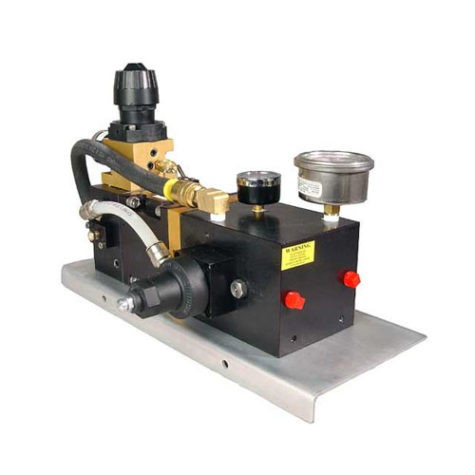
    Max. outlet pressure: 3450-PSI
    Air drive inlet port: ¼” NPTF
    Gas inlet port: ¼” NPTF
    Gas outlet port: ¼” NPTF
    Actual volume per cycle: 0.6 cu-in

    Controls Included:

    Air or manually driven gas booster model 3G-SS-20-O
    Low pressure air controls (filter, regulator, gauge and on/off valve)
    Oxygen gas outlet : ¼” ID x 48” long, 5,000 PSI, S.S. braided hose assembly with high pressure filter, on/off valve, gauges and DIN connector with bleeder
    Oxygen gas inlet: 1/4” ID x 48” long, 5,000 PSI, S.S. braided
    hose assembly with CGA gas cylinder connector
    Oxygen gas outlet port: 1/4” NPTF
    Fits all industrial gas cylinders

    15” H x 8” D x 6” W (38.1 x 20.3 x 15.2 cm)

    Weight: 25 lbs. (11.3 kg.)

    High pressure pilot cutoff valve adjustable (1,000-5,000 PSI) to automatically start/stop the booster when the outlet pressure exceeds set point
    Outlet safety relief valve adjustable (1,000-5,000 PSI)

    How does the HIHP-20648 cylinder-mounted oxygen booster work and what type of air-driven piston mechanism does it use?

    The HIHP-20648 is a cylinder-mounted oxygen booster that raises oxygen pressure using a simple air-driven system. Compressed shop air drives a large pneumatic piston, which moves a smaller high-pressure piston to boost oxygen to about 3,450 psi. The unit is single-acting and automatically cycles, drawing in oxygen on one stroke and compressing it on the next. Because the drive air and compression stages are separate, it can keep boosting even as cylinder pressure drops. The design requires no electricity, only clean compressed air, making it reliable for refilling or servicing high-pressure oxygen systems.

    What inlet and outlet pressure ranges can this oxygen booster handle, and what compression ratio can typically be achieved in aircraft servicing?

    The HIHP-20648 oxygen booster works with inlet pressures that can drop to about 300 psi and still produce a stable high-pressure output. It is designed to deliver oxygen at roughly 3,450 psi for aircraft servicing, allowing full system charging even when the supply cylinder is nearly depleted. In normal use, this results in a compression ratio of about 11:1, which is typical for air-driven aircraft oxygen boosters. This ratio lets technicians maintain consistent high-pressure fills without heavy equipment or electrical power, relying only on clean compressed air to drive the booster’s piston mechanism.

    What fire and explosion hazards are associated with operating an oxygen booster, and what safeguards and inspection steps are required before use?

    Fire and explosion risks arise because oxygen greatly increases the speed and intensity of combustion. In a booster, the main hazards are: ignition from contaminated components (oil, grease, dirt), heat created by rapid compression, adiabatic heating from opening valves too quickly, damaged seals or seats causing friction, and leaks that can feed a fire if ignition occurs.

    Before use, safeguards include: confirming all fittings, hoses, and tools are oxygen-clean; checking for oil or grease contamination; inspecting seals, gauges, and hoses for wear; ensuring valves operate smoothly; confirming drive-air supply is clean and dry; tightening all connections; opening oxygen valves slowly; and verifying proper grounding and ventilation.

    How often should the HIHP-20648 booster be serviced or recertified, and what are the most common troubleshooting steps if it is not building pressure?

    The HIHP-20648 should be inspected routinely and given a full service about once a year, or more often if used heavily or in demanding conditions. Recertification follows manufacturer or aviation-facility requirements rather than a fixed universal interval. If the unit fails to build pressure, common checks include confirming adequate, clean drive-air pressure, inspecting inlet and outlet check valves for sticking, checking for leaks at hoses and fittings, and verifying that safety and cutoff valves are set correctly. Worn seals or pistons are frequent causes of weak compression, so these components should be examined and replaced when performance declines.

    Description Specifications Features Dimensions Options FAQs