
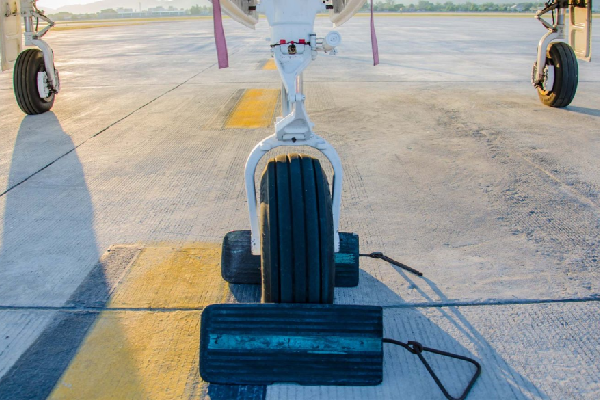
Wheel chocks are primary restraint devices used to prevent unintended aircraft movement during ground operations. Commercial airports, military airbases and MRO facilities classify wheel chocks as essential Ground Support Equipment (GSE).
This guide explains: what are the advantages of rubber wheel chocks over plastic for aircraft?
Grip and Stability on Active Ramps
Aircraft stands are exposed to water, de-icing chemicals, fuel residue and sloped drainage surfaces. Surface contamination reduces friction.
In a safety and grip comparison of rubber vs polyurethane wheel chocks on wet ramp environments, rubber consistently provides higher friction against concrete and asphalt. Higher friction reduces the likelihood of chock displacement when:
- Aircraft settle after engine shutdown
- Refuelling shifts weight distribution
- Ground crews load cargo
- Jet blast affects nearby equipment
Ramp Grip Comparison
| Performance Factor | Rubber Wheel Chock | Plastic / Polyurethane Chock |
| Friction on wet concrete | High | Moderate to low |
| Resistance to oil contamination | Strong | Reduced surface grip |
| Jet blast displacement risk | Lower (greater mass + grip) | Higher (lighter models shift) |
| Performance on sloped stands | Stable | Increased slide risk |
This is important to understand because grip performance directly influences aircraft restraint reliability during turnaround operations.
Durability and Load Rating for Aviation GSE
Aircraft tyres apply concentrated load at contact points. Wide-body commercial aircraft and heavy military transport platforms exert significant downward pressure.
A rubber vs plastic wheel chock durability and load rating assessment for aviation GSE shows that high-grade rubber compounds absorb load and impact more effectively than rigid plastics.
Durability and Structural Performance
| Performance Area | Rubber | Plastic |
| Compression recovery | Maintains shape | Can permanently deform |
| Cold weather behaviour | Remains flexible | May become brittle |
| Heat exposure | Stable under load | Risk of softening |
| Impact resistance | Absorbs shock | Can crack or fracture |
Rubber compounds maintain structural integrity through repeated compression cycles. Plastic materials may experience fatigue over time, particularly in extreme temperatures.
Operational impact: Higher durability reduces replacement frequency and lowers long-term cost of ownership.
FOD Risk and Ramp Hazard Control
Foreign Object Debris (FOD) control is a core safety priority in aviation operations.
There is a documented risk of plastic wheel chocks cracking or creating FOD on airport ramp environments. Plastic fracture can occur due to:
- Repeated heavy aircraft loading
- Freezing temperatures
- Accidental impact from ground vehicles
When plastic breaks, fragments can:
- Damage aircraft tyres
- Become ingestion hazards
- Trigger safety inspections
- Delay departures
Rubber typically deforms under stress rather than shattering. This significantly reduces the chances of debris.
Why it matters: Lower FOD risk improves safety compliance and reduces operational disruption.
Chemical and Environmental Resistance
Airport ramps expose equipment to:
- Jet A1 fuel
- Hydraulic fluids
- Lubricants
- De-icing agents
- UV radiation
Aviation Spares & Repairs wheel chocks are manufactured from high-grade rubber compound that is:
- Chemical-resistant
- Lubricant-resistant
- Weather-resistant
This resistance protects load performance and grip characteristics over time.
Material breakdown reduces effective load rating. Chemical resistance preserves operational reliability.
Weight, Handling and Daily Operations
Wheel chocks must balance stability with practical handling.
Excessively heavy units reduce efficiency during aircraft turnaround. Extremely lightweight units may shift under jet blast.
Aviation Spares & Repairs rubber wheel chocks are engineered to deliver:
- Sufficient mass for stability
- Practical weight for manual positioning
- Reliable grip on hard-standing surfaces
- Suitability for daily commercial and military use
This balance supports safe and efficient ramp workflows.
Size Selection Framework
Correct sizing improves restraint effectiveness and tyre contact area.
Our standard product range includes:
Application Guidance
| Aircraft Category | Typical Chock Size Approach |
| Light aircraft | Small or medium |
| Narrow-body commercial | Medium or large |
| Wide-body commercial | Large |
| Military transport | Large or extra large |
| Specialist vehicles | Custom specification |
Custom manufacturing is available to meet specific tyre dimensions or operational requirements.
FAQs
What are the advantages of rubber wheel chocks over plastic for aircraft?
Rubber chocks offer stronger grip, improved load durability, reduced FOD risk and better resistance to chemicals and weather exposure.
How does rubber compare to polyurethane on wet ramps?
Rubber generally produces higher surface friction on wet concrete and asphalt, increasing stability during ground operations.
Are rubber wheel chocks suitable for military aircraft?
Yes. High-grade rubber wheel chocks are designed for both commercial and military aviation environments.
In Summary
Aircraft ground safety depends on predictable restraint performance. Rubber wheel chocks provide measurable advantages in grip, durability and hazard reduction. For operators requiring dependable Aviation GSE across commercial and military settings, high-grade rubber remains the preferred material choice.