
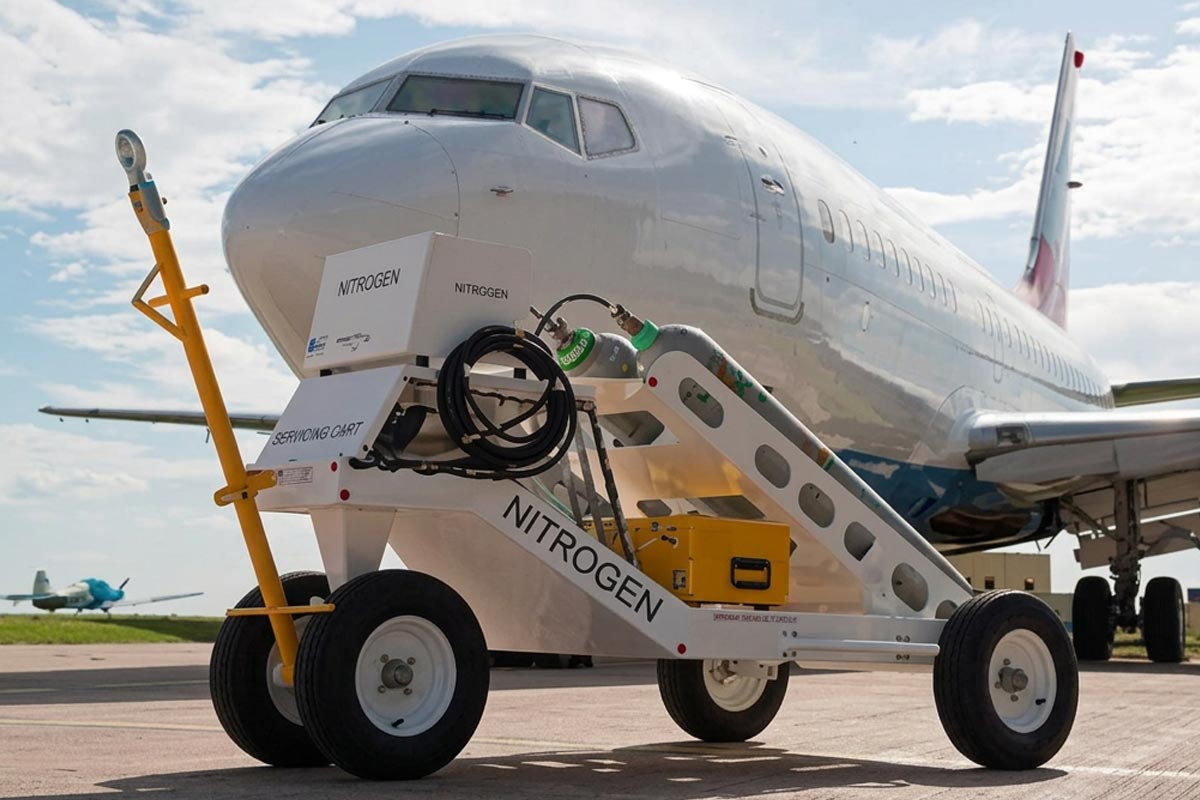
Business jet and regional aircraft tyre inflation requires a high-pressure, aviation-suitable inflation system with accurate pressure regulation, calibrated gauges, safe hoses and compatibility with the approved inflation medium, which may be nitrogen or another inert gas rather than ordinary compressed air. The right compressor depends on the aircraft being supported, the required tyre pressures, the maintenance environment and whether the equipment is being used in a hangar, workshop or line maintenance setting.
Aircraft tyre inflation should never be treated like standard vehicle tyre inflation. Aircraft tyres operate under high loads, high speeds and demanding temperature conditions, so inflation equipment must support safe, controlled and repeatable maintenance.
Aircraft tyre inflation explained: why the right compressor matters
The right compressor matters because aircraft tyre pressure affects tyre life, aircraft safety, wheel assembly stress and maintenance reliability. An under-specified compressor may technically deliver air, but still fail to provide the pressure accuracy, clean dry output or safety control needed for aviation use.
Aircraft tyre inflation equipment needs to help maintenance teams:
- Inflate tyres to the pressure specified in the Aircraft Maintenance Manual
- Avoid uncontrolled overinflation
- Support accurate repeat pressure checks
- Use nitrogen or approved inert gas where required
- Keep moisture and contamination out of the tyre
- Work safely around high-pressure tyre and wheel assemblies
- Support hangar, ramp or line maintenance workflows
This is especially important because aircraft tyres naturally lose pressure over time. The EASA notes that an aircraft tyre can normally lose up to 5% of its pressure within 24 hours and also identifies underinflation as damaging to aircraft tyres and a contributor to tyre break-up or companion tyre failure on multi-wheel assemblies.
What aviation safety figures matter when choosing tyre inflation equipment?
Two figures are especially useful when selecting aircraft tyre inflation equipment: aircraft tyres can lose up to 5% pressure within 24 hours, and some braked-wheel aircraft tyres require inflation gas containing no more than 5% oxygen by volume. These figures show why accuracy, pressure control and approved gas compatibility matter.
| Safety or operational factor | Published figure or guidance | What it means for compressor choice |
| Daily tyre pressure loss | Aircraft tyres can normally lose up to 5% pressure within 24 hours | Choose equipment with accurate gauges and controlled regulation for repeat pressure checks |
| Oxygen content in inflation gas | Some braked-wheel aircraft tyres require no more than 5% oxygen by volume | Check whether nitrogen or approved inert gas inflation is required |
| Underinflation risk | EASA identifies underinflation as damaging and a contributor to tyre break-up | Avoid casual workshop setups, poor gauges or uncontrolled inflation |
| Safe maintenance practice | CAA and EASA guidance highlights tyre pressure, inflation-medium and tyre-burst safety concerns | Select equipment as part of a safe maintenance process, not just by pressure rating |
The CAA’s paper on tyre bursts in flight references requirements for certain braked-wheel aircraft tyres to contain not more than 5% oxygen by volume.
What pressure does an aircraft tyre inflation compressor need to provide?
The compressor or inflation system must be capable of safely reaching the tyre pressure specified in the aircraft’s approved maintenance data, with accurate regulation at that pressure. There is no universal pressure figure for all business jets or regional aircraft because tyre pressures vary by aircraft type, tyre size, wheel assembly, load rating and operating requirement.
That means operators should not choose a compressor based only on its maximum pressure rating. They should also check:
- The regulated output pressure range
- The flow rate at the required pressure
- Gauge accuracy and calibration
- Hose and connector pressure ratings
- Whether the output air is clean and dry
- Whether nitrogen or inert gas compatibility is needed
- Whether the unit can support repeated use without slow recovery
- Whether it is practical for ramp or hangar use
A compressor that can reach a high pressure on paper may still be unsuitable if it cannot deliver that pressure safely, accurately and repeatedly. For suitable compressed-air applications, the MC20 portable compressor is a relevant product example because it is designed for aviation and military ground-support environments and is listed for tyre inflation as well as other pneumatic maintenance tasks.
Can you use a standard workshop compressor for aircraft tyres?
Usually, not on its own. A standard workshop compressor may produce compressed air, but it may not provide the accuracy, dryness, filtration, safety control or approved inflation medium needed for aircraft tyre inflation.
This is an important distinction. The issue is not simply whether the compressor can generate enough pressure. The full inflation setup needs to be suitable for aviation maintenance, including the regulator, gauge, hoses, connectors, moisture control and inflation medium.
A standard workshop compressor may be unsuitable if:
- It cannot reach the required pressure safely
- It does not provide accurate fine pressure control
- It lacks moisture separation or filtration
- It uses uncalibrated gauges
- Its hoses or fittings are not rated for the pressure
- It is not compatible with nitrogen or approved inert gas use
- It is not practical for aircraft ramp or hangar environments
Where nitrogen is required by the aircraft maintenance data, a normal compressed-air system is not a substitute.
Should aircraft tyres be inflated with compressed air or nitrogen?
The correct inflation medium depends on the aircraft and its approved maintenance data, but many aircraft tyre applications require nitrogen or another approved inert gas rather than ordinary compressed air. Nitrogen is widely used because it is dry, stable and helps reduce risks associated with oxygen and moisture inside high-pressure tyres. Where nitrogen servicing is required, operators may need suitable nitrogen and oxygen service carts rather than a standard air compressor alone.
This is where the CAA figure is useful. The CAA’s tyre-burst paper references requirements for certain braked-wheel aircraft tyres to contain no more than 5% oxygen by volume, which supports the need for nitrogen or approved inert gas compatibility in relevant operations. Source: CAA paper on tyre bursts in flight
For business jet and regional aircraft operators, the safe approach is simple: always check the Aircraft Maintenance Manual before deciding whether compressed air is acceptable.
Which aircraft tyre inflation system do you need for different operations?
The right tyre inflation system depends more on aircraft type, pressure requirement, inflation medium and maintenance environment than on tyre size alone. A small business jet operator may need a portable high-pressure unit, while a regional aircraft maintenance team may benefit from a higher-capacity mobile or fixed system. For ramp-side pressure checks, a 300 psi nitrogen tyre service gauge with 12-foot hose is a practical example of equipment designed around controlled inflation, bleeding and pressure display.
| Operation type | Typical requirement | Inflation system to consider | Key buying considerations |
| Small business jet support | Regular pressure checks and occasional inflation | Portable high-pressure aviation inflation system | Accurate regulator, calibrated gauge, clean dry output, aircraft-compatible fittings |
| Mixed business jet fleet | Support for several aircraft types with varying pressure requirements | Higher-capacity portable or trolley-mounted system | Wider pressure range, robust duty cycle, easy movement around hangar or ramp |
| Regional aircraft maintenance | Repeated inflation tasks across larger aircraft | Heavy-duty mobile or fixed high-pressure system | Higher flow rate, reliable recovery, durable hoses, regulator safety |
| Nitrogen tyre inflation operations | Aircraft where nitrogen or inert gas is specified | Nitrogen-compatible inflation and regulation system | Cylinder compatibility, pressure regulation, oxygen-content control, approved fittings |
| Line maintenance or ramp support | Mobile pressure checks away from a fixed bay | Portable inflation trolley or compact high-pressure unit | Manoeuvrability, stable output, safe storage, fast deployment |
This table should be used as a buying guide, not as a pressure chart. The required tyre pressure and inflation medium should always be confirmed from the Aircraft Maintenance Manual, tyre placard or other approved maintenance data.
How do you choose the right compressor for business jet and regional aircraft operations?
Start with the aircraft you support, then match the compressor or inflation system to the highest pressure, gas and operational requirements across that fleet. For business jet and regional aircraft operations, the right choice is usually the system that offers the safest combination of pressure capability, regulation accuracy, portability and approved gas compatibility.
Before selecting equipment, operators should confirm:
- Which aircraft types are being supported
- The specified tyre pressures for each aircraft
- Whether nitrogen or another inert gas is required
- Whether the equipment will be used in a hangar, workshop, ramp or line maintenance setting
- How frequently tyres need checking or inflating
- Whether the unit needs to be portable
- Whether gauges and regulators can be calibrated
- Whether hoses and connectors are pressure-rated and aviation-suitable
- Whether air quality, dryness and filtration are adequate
For mixed fleets, it is usually better to choose an inflation system with enough capability for the most demanding aircraft in regular service, rather than choosing a lower-spec compressor that only suits part of the operation.
What features should an aircraft tyre inflation compressor have?
The most important features are high-pressure capability, accurate regulation, calibrated pressure measurement, clean dry output and safe aviation-compatible fittings. The system should make inflation controlled and repeatable, not improvised. This is where dedicated nitrogen and oxygen gauges can support more consistent aircraft servicing than general workshop equipment.
Key features include:
- High-pressure output suitable for the aircraft supported
- Fine pressure control through a quality regulator
- Calibrated pressure gauges
- Moisture separation and filtration
- Clean, dry air delivery where compressed air is approved
- Compatibility with nitrogen systems where required, including the correct nitrogen inflating valve adapter
- Heavy-duty hoses rated for the working pressure
- Strut and tyre tools, including aircraft tyre inflation connectors, chucks and valve tools
- Safety relief protection
- Portable or trolley-mounted design where needed
- Robust construction for hangar and ramp use
The compressor should be assessed as part of the full inflation system. A powerful compressor with poor regulation, unsuitable hoses or inaccurate gauges is still the wrong choice.
What mistakes should operators avoid?
The biggest mistake is choosing a compressor by maximum pressure alone. Aircraft tyre inflation requires controlled pressure delivery, correct gas selection and safe maintenance practice.
Operators should avoid:
- Treating aircraft tyre inflation like car tyre inflation
- Using a compressor without checking the aircraft maintenance data
- Assuming compressed air is acceptable when nitrogen is required
- Using uncalibrated or inaccurate pressure gauges
- Using hoses or fittings not rated for the working pressure
- Ignoring moisture control in compressed air systems
- Relying on tyre size alone to choose equipment
- Choosing a portable unit that cannot maintain stable output
- Failing to train staff on high-pressure inflation safety
Final answer: what compressor do you need?
For business jet and regional aircraft tyre inflation, you need a high-pressure aviation inflation system with accurate pressure regulation, calibrated gauges, suitable hoses and compatibility with the required inflation medium. In practice, that may mean a portable air compressor for approved compressed-air tasks, nitrogen service equipment for inert-gas inflation, and dedicated gauges, hoses and tyre tools for safe pressure control.
The key decision is not simply “what tyre size do I have?” but:
- What aircraft types do you support?
- What tyre pressures do those aircraft require?
- Is nitrogen or inert gas specified?
- How often will the equipment be used?
- Does the system need to be portable?
- Can it deliver controlled, clean and repeatable inflation?
Because aircraft tyres can lose up to 5% pressure within 24 hours, and because some braked-wheel tyre applications require no more than 5% oxygen by volume, operators should prioritise accuracy, control and approved gas compatibility over generic compressor specifications.
FAQ
Can any compressor inflate aircraft tyres?
No. Aircraft tyre inflation should only be carried out with equipment suitable for the required pressure, safety procedure and inflation medium. A standard compressor may not provide the control, air quality or nitrogen compatibility needed for aviation use.
Do aircraft tyres need nitrogen?
Many aircraft tyre applications require nitrogen or another approved inert gas, but the correct requirement must be checked in the aircraft maintenance data. CAA-published guidance references a requirement for no more than 5% oxygen by volume in tyres fitted to certain braked wheels.
Why is aircraft tyre pressure checked so often?
Aircraft tyres can lose pressure naturally, and EASA notes that an aircraft tyre can normally lose up to 5% of its pressure within 24 hours. Regular checks help prevent underinflation, which can damage tyres and increase failure risk.
Is tyre size enough to choose an aircraft compressor?
No. Tyre size alone is not enough. Operators also need to know the aircraft type, specified tyre pressure, inflation medium, wheel assembly requirements and maintenance environment.
What is the most important compressor feature for aircraft tyre inflation?
Accurate pressure regulation is one of the most important features. Aircraft tyres need controlled inflation to the specified pressure, using calibrated gauges and pressure-rated fittings.
Is a portable compressor suitable for aircraft tyre inflation?
Yes, provided it meets the required pressure, safety and inflation-medium requirements. Portable systems can be useful for hangar and ramp support, but they must still be aviation-suitable.