
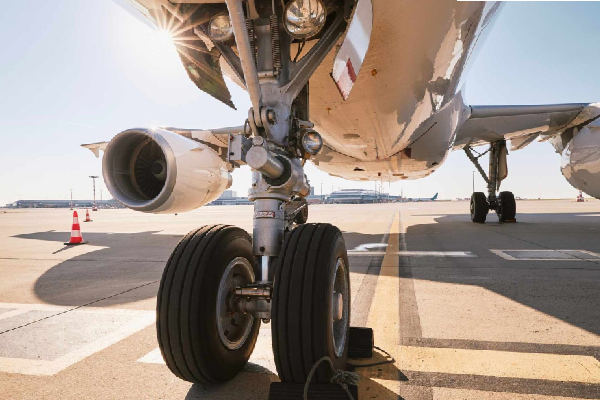
A flat tyre disables an aircraft immediately. The wheel can no longer support the aircraft evenly, brake lines become vulnerable, and any attempt to roll the aircraft risks additional structural damage. For FBOs, MROs and airport operators, the priority is to move the aircraft safely while restoring normal operations on taxiways, stands or runways as quickly as possible.
This guide explains how ground teams handle flat-tyre aircraft recoveries and how Aviation Spares & Repairs’ wheel equipment – particularly the Iron Tire Aircraft Flat Tyre Dolly – is used to reposition disabled aircraft efficiently.
Why Flat-Tyre Aircraft Cannot Be Rolled
A flat tyre causes the wheel to sit at an abnormal angle. The rim bears more load than intended, and brake lines, linkages and callipers are exposed. Rolling the aircraft, even a few inches, can pull a tyre off the bead, bind it inside the brake calliper, or score the rim.
In many cases, the tyre is already shredded or partially detached, so rolling the aircraft only worsens the condition.
From an operations standpoint, allowing an aircraft to roll on a flat tyre is rarely permissible. Manufacturers typically warn against it, and airport safety teams treat the scenario as a disabled aircraft event requiring controlled recovery equipment.
Short summary: A flat tyre exposes brake lines and structural components; rolling the aircraft is unsafe and usually prohibited.
What the Iron Tire Aircraft Flat Tyre Dolly Does
The Iron Tire Aircraft Flat Tyre Dolly is designed specifically to move aircraft with flat, shredded or off-bead tyres without requiring the wheel to roll. The dolly lifts the wheel by the tyre itself, avoiding contact with any brake assemblies or structural parts.
The dolly can handle aircraft up to 20,000 lbs (9,071 kg), supports one-person operation, and completes a recovery in under five minutes. Because it attaches to the aircraft only through the tyre, it eliminates the risk of accidental contact with brake lines, gear doors or hydraulic linkages.
It also works in cases where the tyre is trapped inside the brake calliper or has completely failed.
Short summary: The Iron Tire Dolly supports only the tyre and prevents the aircraft from rolling, making it the safest method for clearing a disabled aircraft.
Why Airports and FBOs Use the Iron Tire Dolly Instead of Jacking
Traditional recovery requires jacking the aircraft, removing the wheel and fitting a replacement. This demands a multi-person team, aircraft-specific jacks, and careful lifting around vulnerable brake lines. Jacking also takes time: typically half an hour to two hours depending on aircraft type and location.
The Iron Tire Dolly bypasses the entire wheel-removal process. The aircraft does not move during loading, and the wheel does not rotate. Once the wheel is captured, the aircraft can be towed directly to a hangar or maintenance bay.
This is important because:
- It avoids the risk of damaging gear components during jacking.
- It reduces airfield obstruction time.
- It allows quick towing away from a taxiway or runway without waiting for mechanics or replacement parts.
Short summary: The dolly is faster, safer and less labour-intensive than lifting the aircraft to change the wheel on the spot.
How the Iron Tire Dolly Works on Different Aircraft Types
The dolly is designed to work with both small and medium-sized aircraft, including fixed-gear and retractable-gear models, and can be used on nose, main or tail gear.
It does not depend on perfect alignment; the heavy-duty swivel casters allow it to self-centre beneath the tyre.
Two universal towbar attachment points let operators approach the aircraft from either direction, placing the dolly exactly where needed, even in tight hangar environments.
Because it contacts only the tyre, the dolly avoids all critical components. This protects brake lines, seals, torque links, gear shrouds and painted surfaces from damage during recovery.
Short summary: The device is aircraft-agnostic and safe to use across varied gear configurations.
Operational Framework for Moving a Flat-Tyre Aircraft
Most operators follow a simple sequence which ensures both speed and safety:
- Secure and assess the aircraft.
Ground crew confirms the tyre’s condition, checks brake line exposure and informs airport operations or ATC if movement areas are affected. - Obtain authorisation.
Movement is approved by the airline duty engineer, MRO supervisor or airport operations manager, depending on location. - Position the Iron Tire Dolly.
Operators tow it into position and let the casters self-align beneath the disabled tyre. - Lift and secure the wheel.
The dolly lifts the tyre without requiring the aircraft to roll or be jacked. - Tow the aircraft to a safe location.
The aircraft is moved at reduced speed to a stand or hangar for permanent repair.
This method shortens the time that taxiways or runways remain obstructed and keeps the recovery controlled.
Short summary: A structured sequence enables crews to move aircraft quickly while keeping brake lines and gear assemblies protected.
Equipment From Aviation Spares That Supports Recovery and Tyre Handling
At Aviation Spares & Repairs, we also offer maintenance equipment used after the aircraft is removed from the movement area.
Aircraft Tyre & Brake Dolly:
Designed for safe handling of wheels and brake discs during maintenance. It supports older and modern aircraft types, including Boeing 707, Boeing 737, DC-8, L-1011 TriStar and Airbus A320.
It removes the need for technicians to lift heavy wheel assemblies manually.
Aircraft Tyre Service Trailer:
A dedicated trailer that carries two spare aircraft tyres, aircraft jacks and service tools. Its spring-loaded ramp enables quick loading and transport to remote stands or apron locations.
Short summary: These tools support tyre change, brake work and workshop tasks once the disabled aircraft has been relocated.
When Is It Permissible to Roll an Aircraft on a Flat Tyre?
Rolling is permissible only under explicit engineering approval and generally only if the tyre still retains enough structural integrity to protect the rim and brake lines.
In practice, this is rare. The Iron Tire Dolly eliminates the need to consider rolling at all, which prevents secondary damage and simplifies the decision process.
Short summary: Rolling is nearly always avoided; the dolly provides a consistent, risk-free alternative.
Time Required to Clear a Disabled Aircraft
Clearance times vary depending on equipment:
| Method | Typical Clearance Time | Notes |
| Iron Tire Dolly | Under 5 minutes once in position | Fastest, no jacking or wheel removal |
| Jacking + wheel change | 30–120 minutes | Requires personnel, tools and safe jacking location |
| Attempting limited rolling | Unpredictable and high-risk | May worsen damage; not recommended |
Short summary: The Iron Tire Dolly restores airport mobility far faster than any alternative.
FAQs
Can the Iron Tire Dolly move shredded tyres?
Yes. It can lift tyres that are off the bead, shredded or jammed in the brake calliper.
Does the dolly touch the aircraft structure?
No. It contacts only the tyre, which prevents damage to brake lines or gear components.
How many people are needed?
One operator can position, load and tow the aircraft.
Can it be used on all gear positions?
Yes. It works on nose, main and tail gear.
Why not change the aircraft wheel on the taxiway?
Jacking on an active apron or taxiway is slow, requires multiple technicians and increases obstruction time.
Conclusion
A flat aircraft tyre demands a recovery method that protects the aircraft while keeping airfield operations flowing. The Iron Tire Aircraft Flat Tyre Dolly provides the safest and fastest way to clear disabled aircraft from taxiways and runways, without rolling the tyre or jacking the aircraft in difficult environments.
Supported by the Aircraft Tyre & Brake Dolly and the Aircraft Tyre Service Trailer, Aviation Spares & Repairs offers a complete set of tools for FBOs and MROs managing wheel and brake events efficiently.