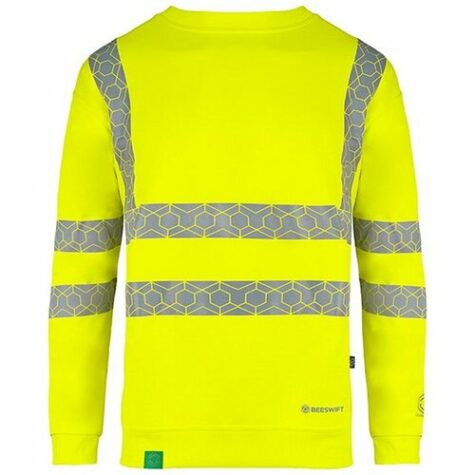
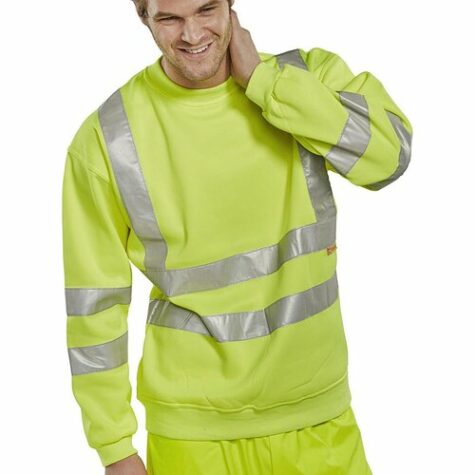
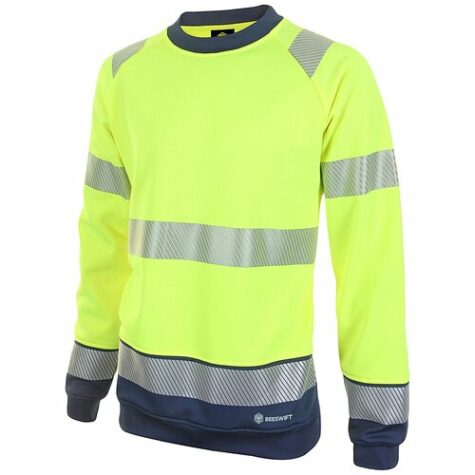
Product Description
• Fire Retardant, Anti-Static, Hi-Vis Orange, ARC Flash Sweatshirt.
• GO/RT 3279 issue 8 2013 for use on or around railway lines.
• 260-280gsm 41% Modacrylic, 30% Polyester, 27% Cotton, 2% Carbon.
• Inherently flame retardant.
• Fire Retardant properties will not diminish with repeated laundering.
• Ribbed cuffs.
• Ribbed waistband.
• For industrial workers exposed to heat.
• Not suitable for fire fighters.
EN ISO 13688:2013 – General requirements for protective clothing
EN ISO 20471 : 2013 (Class 3) – GORT 3279 2013 Issue 8
EN 1149-3:2004 – Anti Static – Test methods for measurements of charge decay
EN ISO 11612:2008 (A1 B1 C1) – Protection against heat and flame
ARC FLASH
IEC 61482-2:2009 – Performance requirements and design requirements
EN 61482-1-2 : (Class 1= 4kA) – Box Arc testing
EN 61482-1-1:2009 (ATPV = 12.8 Cal/cm2) – Open Arc testing
• Each garment style is independently tested to both box and open ARC standards.
• Click ARC production is covered by article 11B certification.
EN 61482-1-1:2009 – Protection against arc flash – Open arc
ATPV 12.8 Cal/cm²
EN ISO 11612:2015 – Clothing to protect against heat and flame
Flammability (Flame is applied horizontally) A1
Convective Heat B1
Radiant Heat C1
EN ISO 20471:2013+A1:2016 – High Visibility Clothing
Class 3 (0.80m2)
EN ISO 13688:2013 – Protective clothing. General requirements
RIS-2179-TOM Issue 2 – Rail Industry Clothing
EN 1149:2018 – Protective clothing. Electrostatic properties. Material performance and design requirements